To prepare for one of my most anticipated trips, I read a novel set in Marrakech and the Atlas Mountains, checked the weather, and consulted ChatGPT for a packing list. That didn’t seem quite enough, so while in the airport and on the redeye flight from NYC to Morocco, I read parts of National Geographic’s book on Morocco – the sections on history, culture and Marrakech, in particular. I learned that Morocco is similar in size and population to California. The difference is that almost all of California’s people (94%) live in urban areas. In Morocco just over half of their population lives in urban areas (60%).
When we landed on the African continent, I still had absolutely no idea what to expect.

After arriving in Marrakech and going through immigration, I noticed an interesting saying on the wall. “Marrakech. Marvelous. Magnificent. Magical (and other “M” words)”. So cool and a perfect blogpost theme! Click. The first photo of my blogpost. Oof. Not so fast. A Moroccan immigration official stopped me and deleted the photo. Well snap. I’ll need a new theme. It wasn’t long before one presented itself.
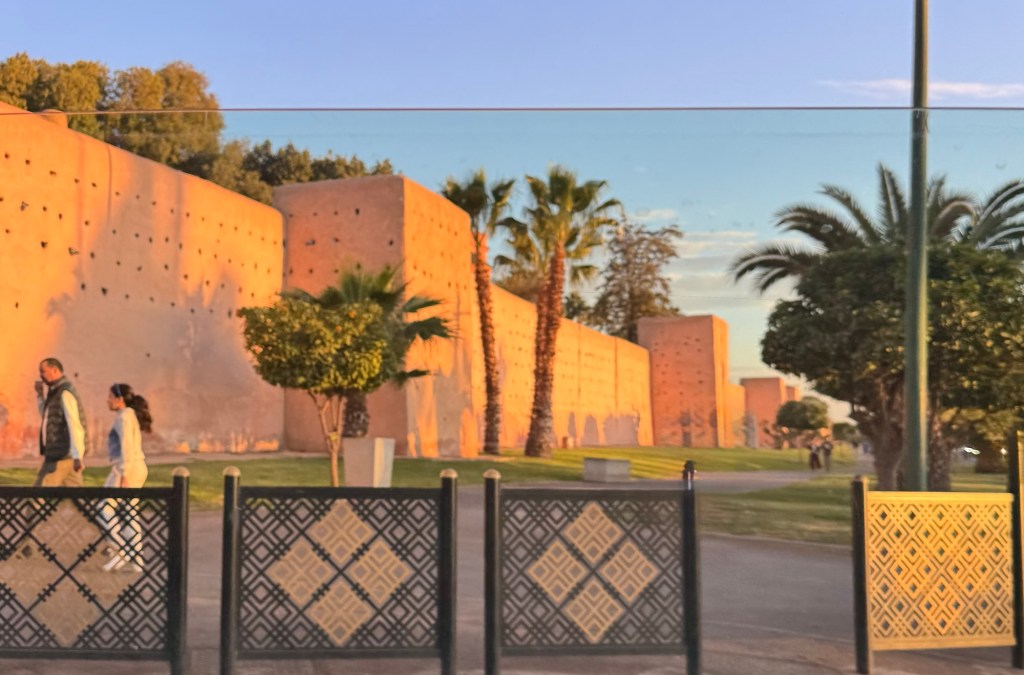
After leaving the airport (whew!) and on our way to the hotel, the first “door” we passed through was one of the nineteen gates piercing the twelve mile wall surrounding the Medina – the historic heart of Marrakech and UNESCO World Heritage site. The terracotta wall in the photo above was constructed in the 12th century by the Almoravid dynasty – one of Morocco’s early Islamic empires.
Morocco has a colorful and varied history including the indigenous Amazigh (Berber people dating to before 1,000 BCE), Phoenician and Roman influence (think Mark Antony – yes, Julius Caesar’s buddy), Islamic arrival and early kingdoms, Berber dynasties and Imperial rule, Alaouite Dynasty (1666–present), Colonial Period (1912–1956) which includes protectorates of Spain and France, and finally, Independence in 1956.
Once inside the Medina, the taxi from the airport drove us past La Mamounia (the hotel made famous by Winston Churchill), the Koutoubia Mosque, and several shops along the busy two lane road, before making a tight u-turn through heavy traffic and coming to an abrupt stop at a set of ornate metal black doors amongst the rundown run-of-the-mill shops. As we exited the taxi, I was drawn to a pervasive sound- almost a mantra. It was the early afternoon call to worship coming from the mosque we had just passed. It was then when I realized that my first trip to a Muslim country would be different. I had so much to learn. And I was eager to get started.

With my iPhone and my camera at the ready, I was excited to take in more information from our guide through the Souks in the Medina that afternoon. We met our guide, Abdel, in our hotel lobby and headed to the Medina. He gave us some general information about Marrakech and Morocco. I wish I had taken notes; Abdel was a treasure trove of knowledge. We walked past the mosque and several fruit/juice vendors on our way into the Souk.
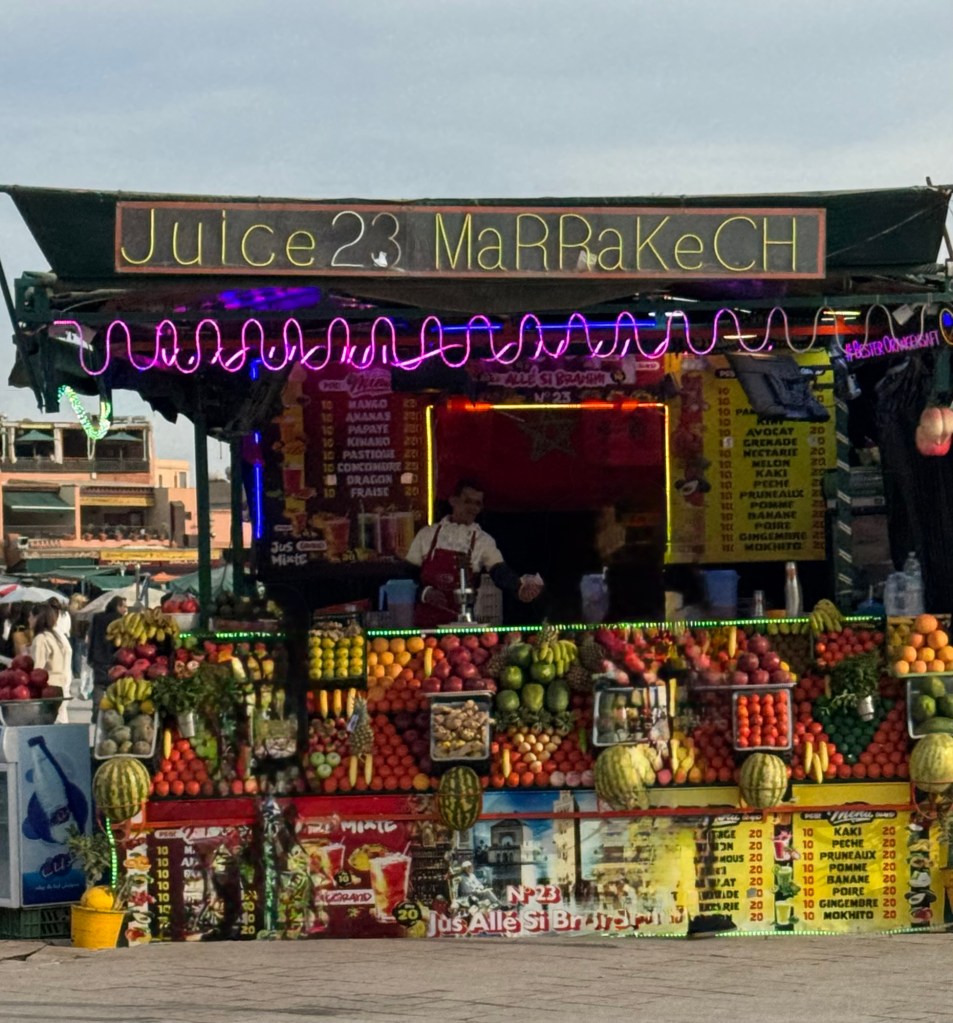
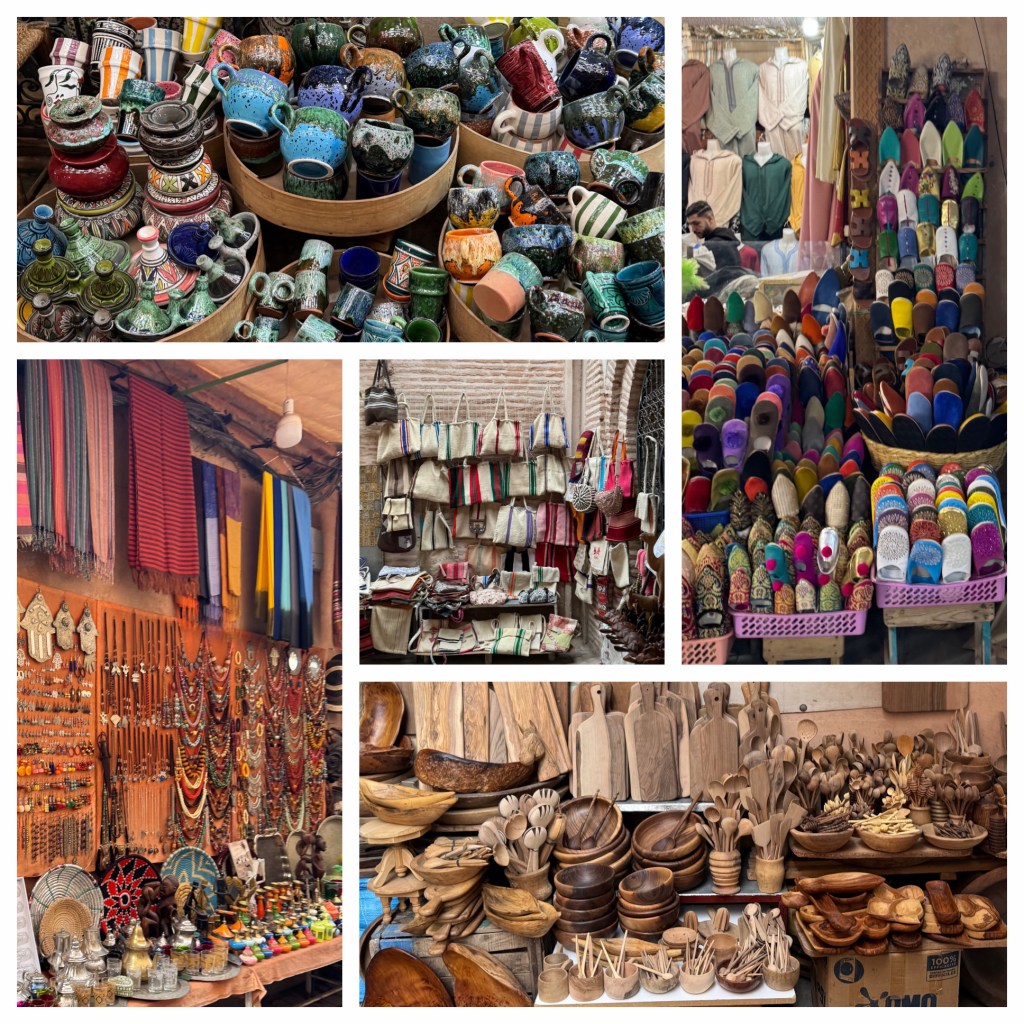
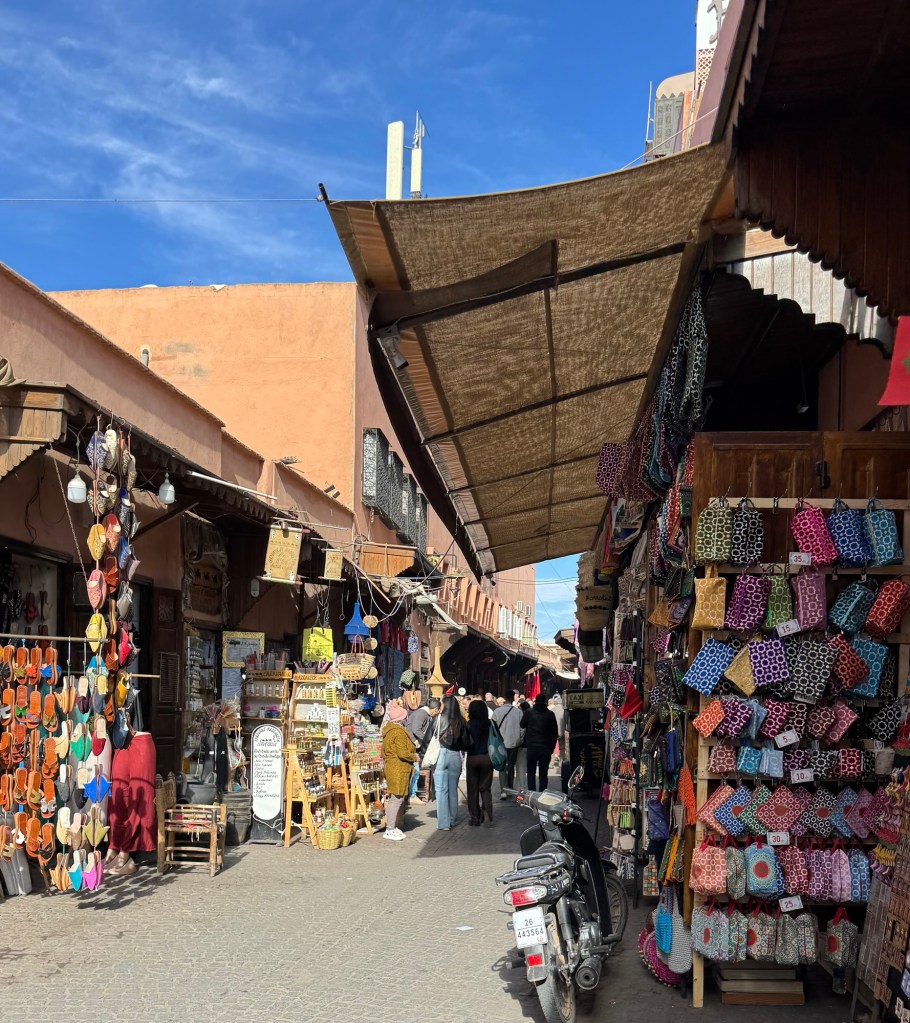
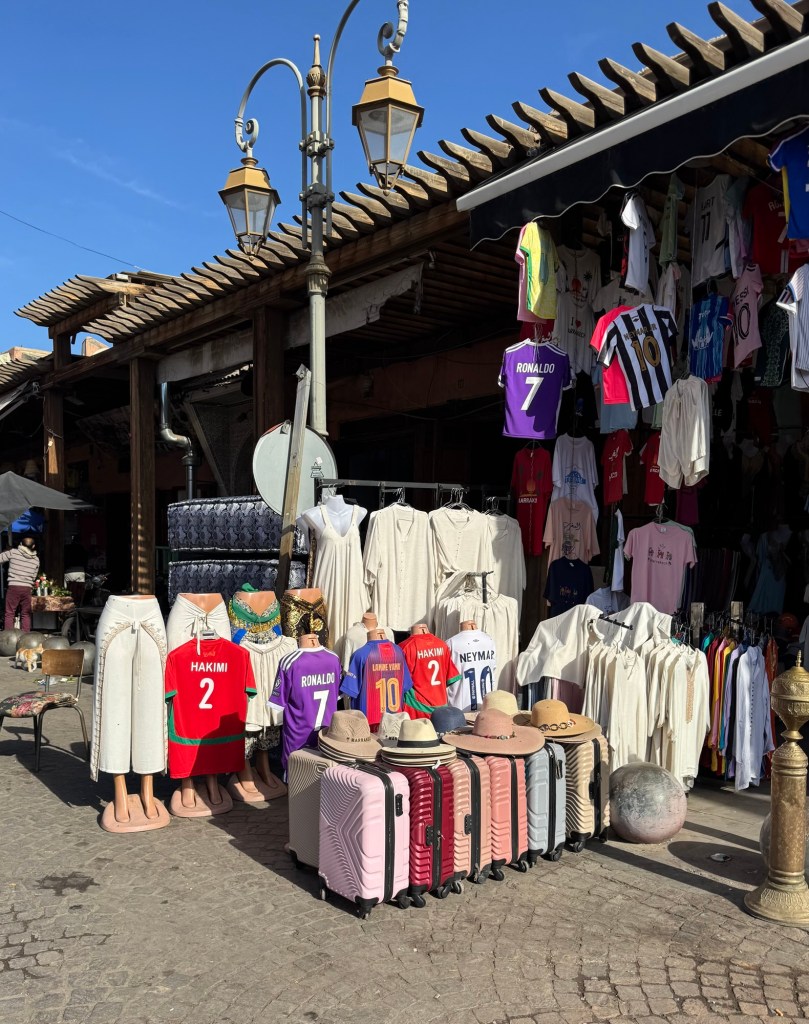
The Souk was filled with people (A LOT of tourists) and a few street cats. Specific shops for pottery, textiles, trinkets, spices, metal work, clothes, jewelry, and shoes as well as fruit stands, restaurants, coffee shops, and even a pet store lined the walkways of the market. It seemed that most of the souk was now geared toward the tourists although there were still areas for the locals. It was also hard to tell the genuine crafts from items made in China.
Revelry with dancing and outdoor dining (an older version of food trucks) filled the plaza outside the souk as night settled in. Before we let our guide go for the night, we booked him for the following morning.

That evening before dinner we went to our hotel’s rooftop to relax. Like clockwork, the mosques called their followers to prayer as the sun set. We were surprised to hear the calls coming from two mosques. We later realized it was the Koutoubia Mosque we had seen earlier and the mosque in the Kasbah which we would see the next day.

The mission the next day was a walking tour of the Kasbah. We came to find out that our guide, Abdelouahad (Abdel for short), was born and raised there. It was such a delight to see him walk down memory lane and greet people he’d known for decades. I asked him how large the Kasbah was. His answer “the whole world”. At least from a child’s perspective it was. In reality it’s about 100 acres and a bit more than six percent of the entire Medina. Some things have changed since he lived there. Some have not.
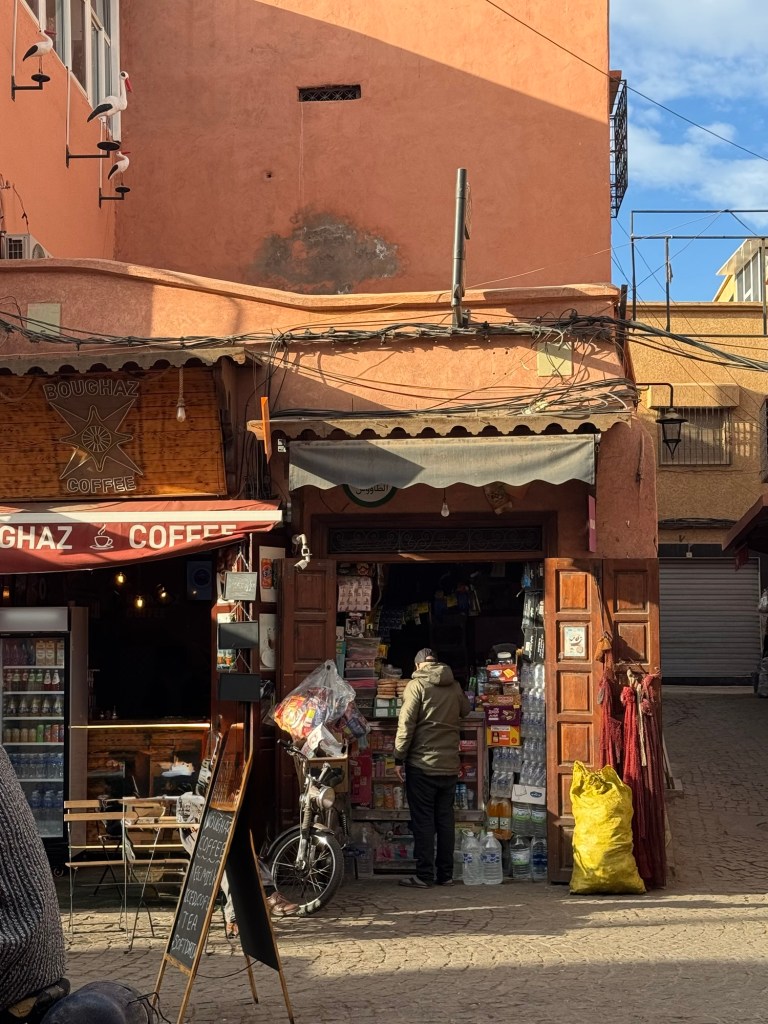

Abdel taught me that humbleness is one of the tenets of Islam. You never know what lies behind a door. It might be a humble abode or a gorgeous Riad with a courtyard. Just as you never know the quality of clothes beneath the often worn long striped jacket, a djellaba. Even the palace entrance is plain with no clue as to the beauty one finds inside its walls.


Several things stuck in my head from our walk through the Kasbah with Abdel that morning. The first was that Abdel worshiped at that local mosque (the one we heard the night before) as a child. How cool is that?! He talked with us about the practicality of praying five times a day while working. Which basically boiled down to pray when you’re able to.

Second, because of the tourist attractions in and near the Kasbah some of the grocery markets for the residents have now changed to dry goods shops for the tourists forcing the residents to go farther for their food.
Third, tourism has picked up significantly in the last several years. Maybe because in 2022 Morocco made it to the semi-finals in the World Cup (the first Arab nation to do so).
Third, it is obvious that some of the people who are not in the tourist industry are not comfortable with all the foreigners and their cameras – especially in the food markets. Fourth, the shops are so specific that there is one butcher for beef and another for poultry. The beef vendor has quarter cows hanging from the ceiling and poultry guy has live chickens just behind his refrigerated counter from which customers could choose. You can see why tourists would be interested in photos.
And finally, I realized that dates were from palm trees. I saw the date palm trees and assumed that they were coconut palm trees. Our guide told us that he and his buddies would run around shaking trees then watch dates fall and eat them. A perfect little snack for boys playing in the Kasbah. Until this trip I thought dates were a dried fruit because of their wrinkled skin. Nope, they’re edible straight off the tree!

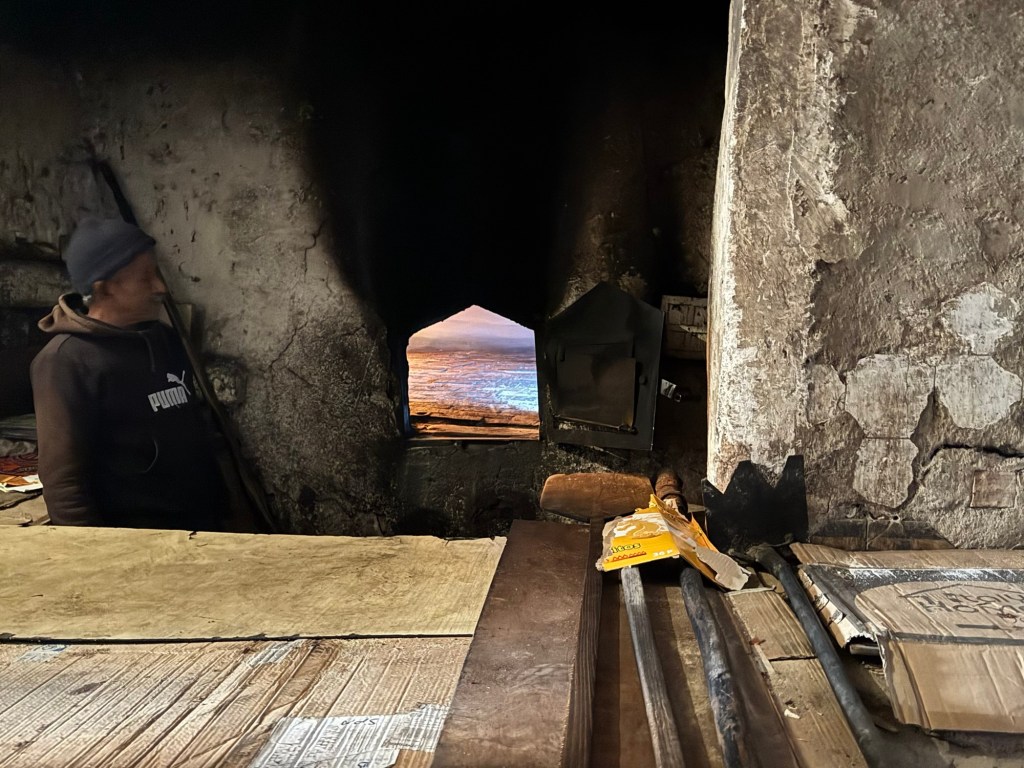
Abdel spoke a lot about the community bakery. Not where you would go to buy bread, but one where you go to bake bread. Abdel’s mother would prepare the dough let it rise at home and when it was ready to be put in the oven, she’d have one of her boys walk the pan to the baker. It must not have been far from his house because the baker was the next photo after photos of Abdel’s neighborhood. The photos after the baker were ones from the market. They must all be near each other.
Archways were everywhere in the Medina. I came to find out that they provide shade, strengthen buildings, and help keep narrow streets cooler. They also reflect Islamic architectural traditions that favor curved forms, balance, and a clear sense of transition.

Our time spent in the Medina was truly special. Our guide and his ability to explain what we were seeing made the experience unforgettable. I highly recommend hiring a local guide when you travel. He lead us through countless doors, corridors and passages. Each time I stepped through a new “doorway” I found myself curious about what I might discover next. It was a reminder that the most meaningful journeys often begin by simply stepping through the next door.
As always, thanks for reading.💕
 New City New State
So interesting and I always learn something from your writings, Michelle! Thank you!
Christine
LikeLiked by 1 person