When planning our Moroccan adventure, we decided that after two nights in Marrakech we would stay local(ish) rather than flying off to other parts of Morocco. We just had to get to there. So we rented a car and drove to three different locations outside of the city, all relatively near the base of the High Atlas Mountains. The roads were very nice. The driving not so much. We were shocked by how many people passed on blind curves.
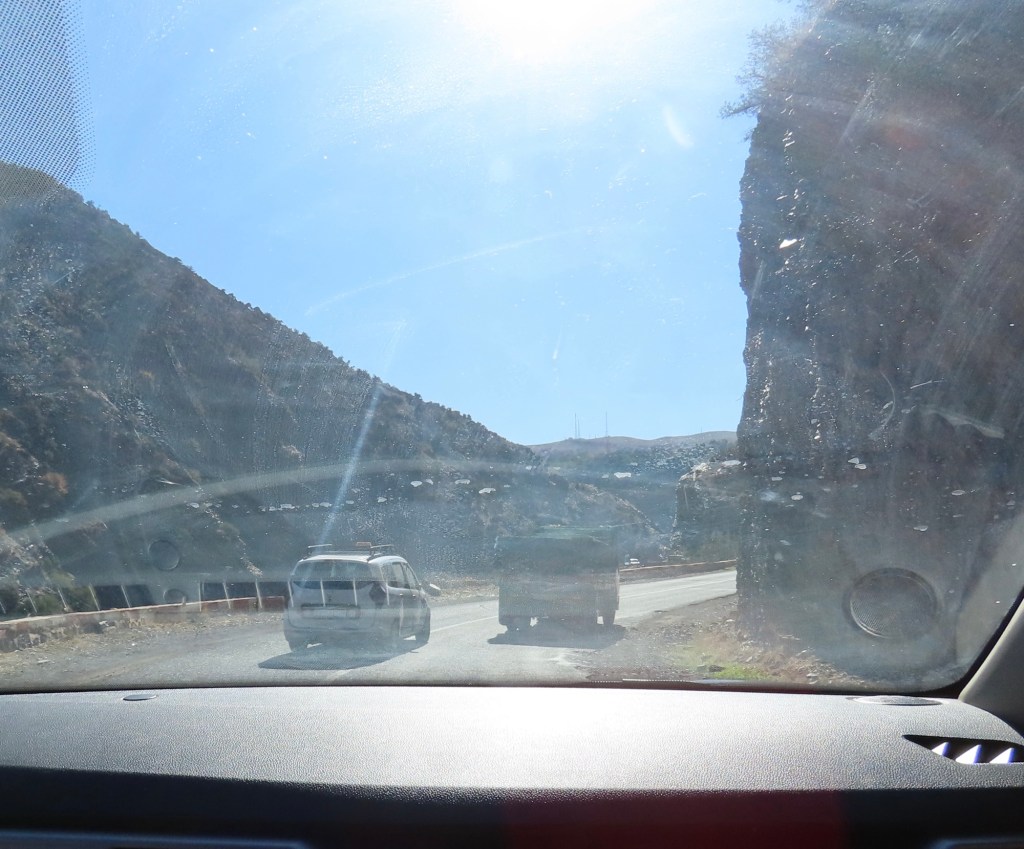
Our next surprise was that most people hired for front desk jobs and waitstaff knew at least four languages: Moroccan Arabic, Berber, French and English. And some knew more. The policemen, too, know English. At least the one who pulled us over for driving too fast just outside of a town did. Instead of sitting in cars and using a radar gun, the policemen stood in the middle of the street and either waved people over or waved them on. Most of the time we were waved on.
In addition to the waitstaff and policemen, our guides spoke great English – even if they did apologize for it often. Imagine apologizing in your fourth language that it’s not good enough. Impressive.
I started getting so much information that I had to start taking notes. Some remarks I jotted down and later looked up. One of the comments was that Morocco was the first nation to recognize the United States of America. Seemed odd, so I did a bit of research.
Indeed, Morocco was the first nation to recognize the United States. In 1777, Sultan Mohammed III opened Moroccan ports to American ships, effectively recognizing the newly independent nation. This relationship was later formalized with the Moroccan–American Treaty of Friendship in 1786, which remains the longest unbroken treaty in U.S. history.
Our excursions from those hotels included a tangine cooking class starting with a Berber coffee, a mule ride to a nearby Berber village with an afternoon tea hosted by a local family, a walk through an old Berber village and an afternoon tea with a local female beekeeper (she’s also a gardener and educator), an evening sunset adventure to listen to stories as the sun set while drinking an evening tea, and finally, an excursion to buy a jacket at a tourist rug store which, you guessed it(!), included a tea service.
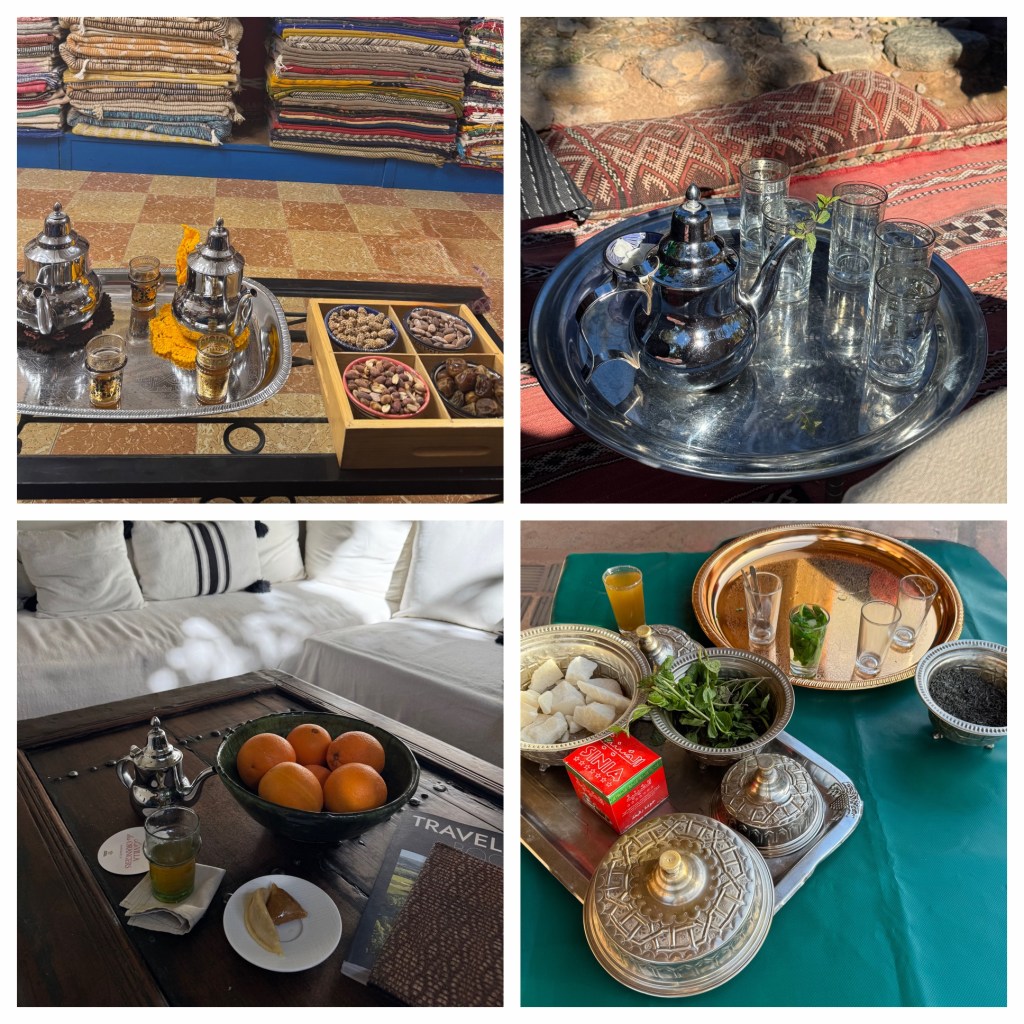
Green tea flavored with mint and a touch of sugar.
We spent about ten hours driving between hotels. We drove through one of the most picturesque passes through the High Atlas Mountains, the Tizi n’Tichka Pass, not once, but twice. The first time it was rainy and overcast. The second time it was snowing. Neither are great for photos. But I did manage to capture a few interesting images.

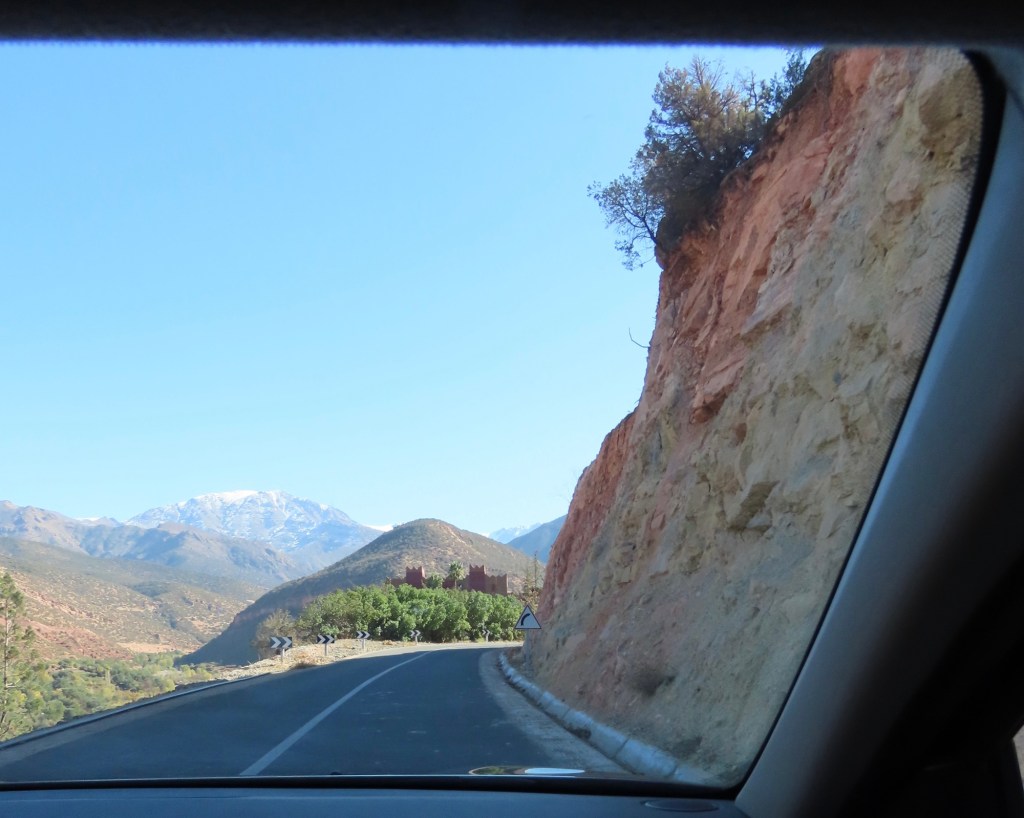
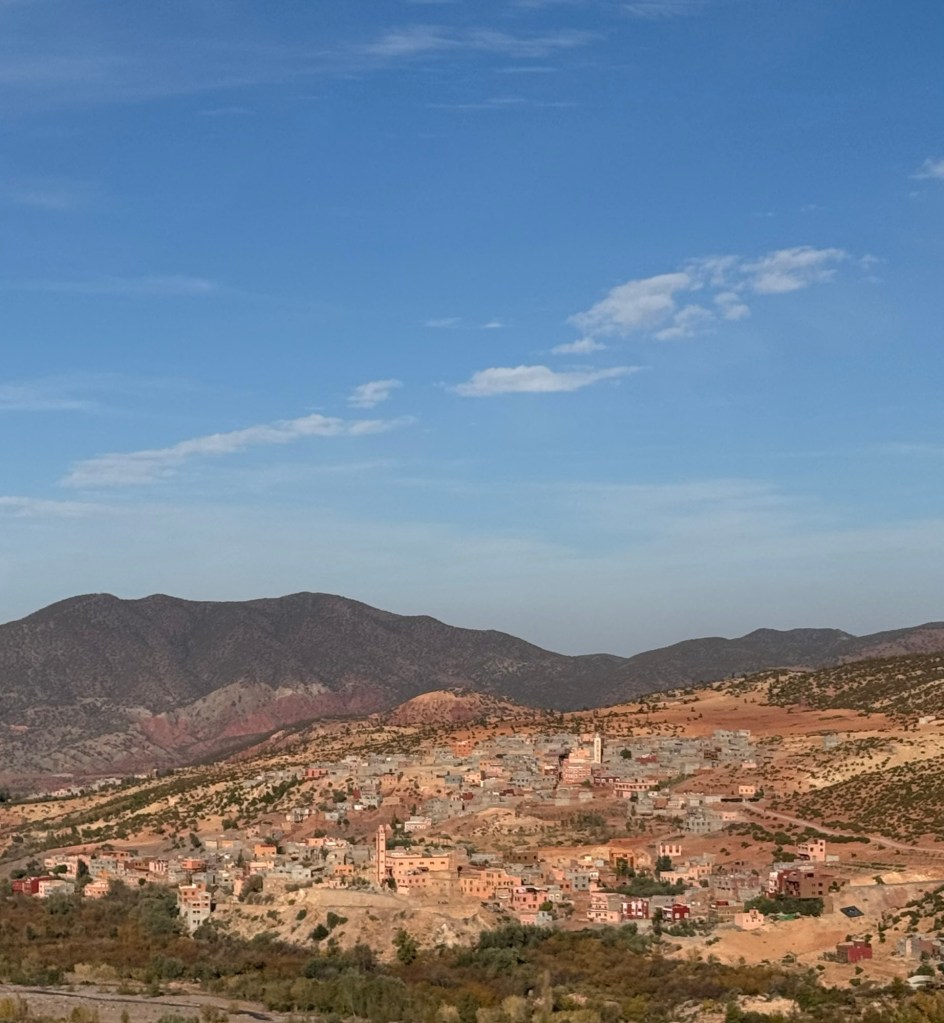
During our journeys I noticed a trend. There weren’t a lot of random small villages strewn about. They were clustered near a larger main village. Asni, a town near where we stayed the first two nights outside of Marrakech, had a dozen or so small villages near it. All contained their own market, school and mosque. This pattern repeated itself at the next two places we stayed, each surrounded by a dozen or more villages clustered together.



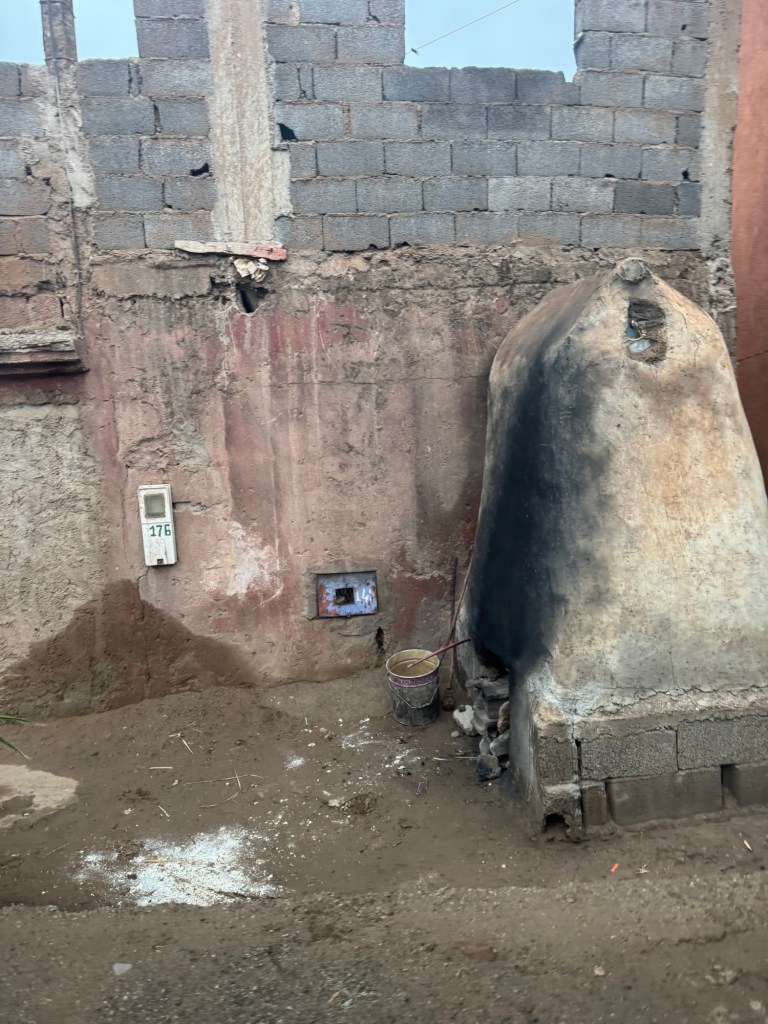
Another notable discovery was the amount of devastation still evident from the earthquake in September of 2023. The 6.9 magnitude with an epicenter in the High Atlas Mountains killed nearly 3,000 people. The gray colored unfinished rebuilds amongst the terracotta colored homes are easily identified from the road.
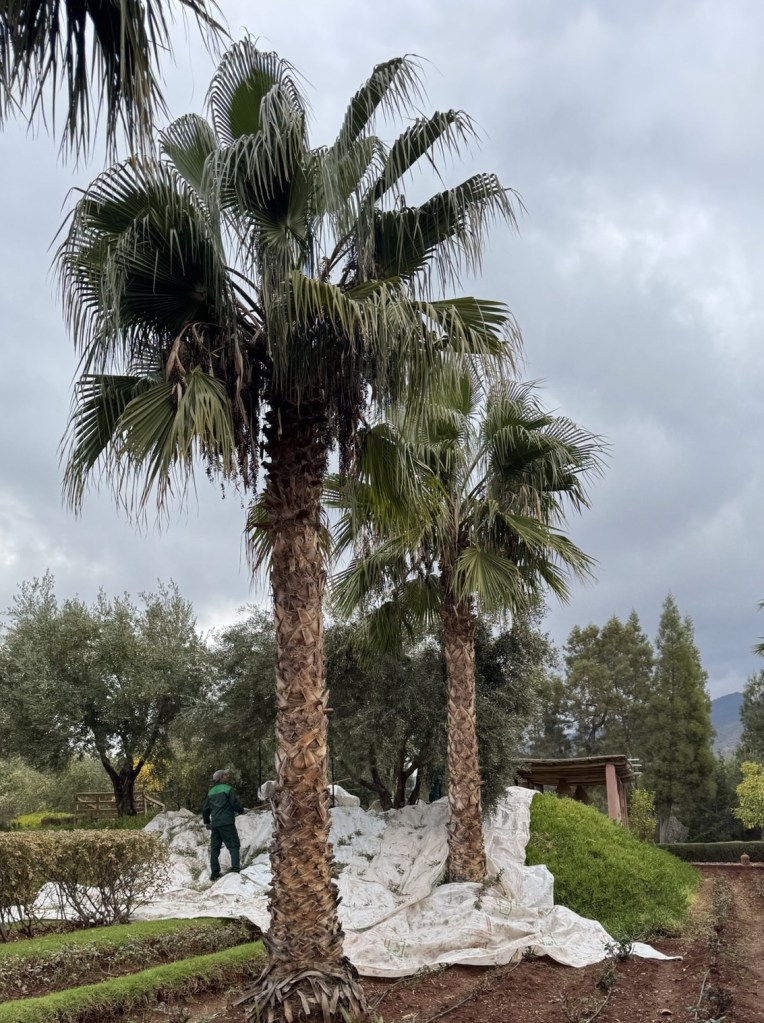
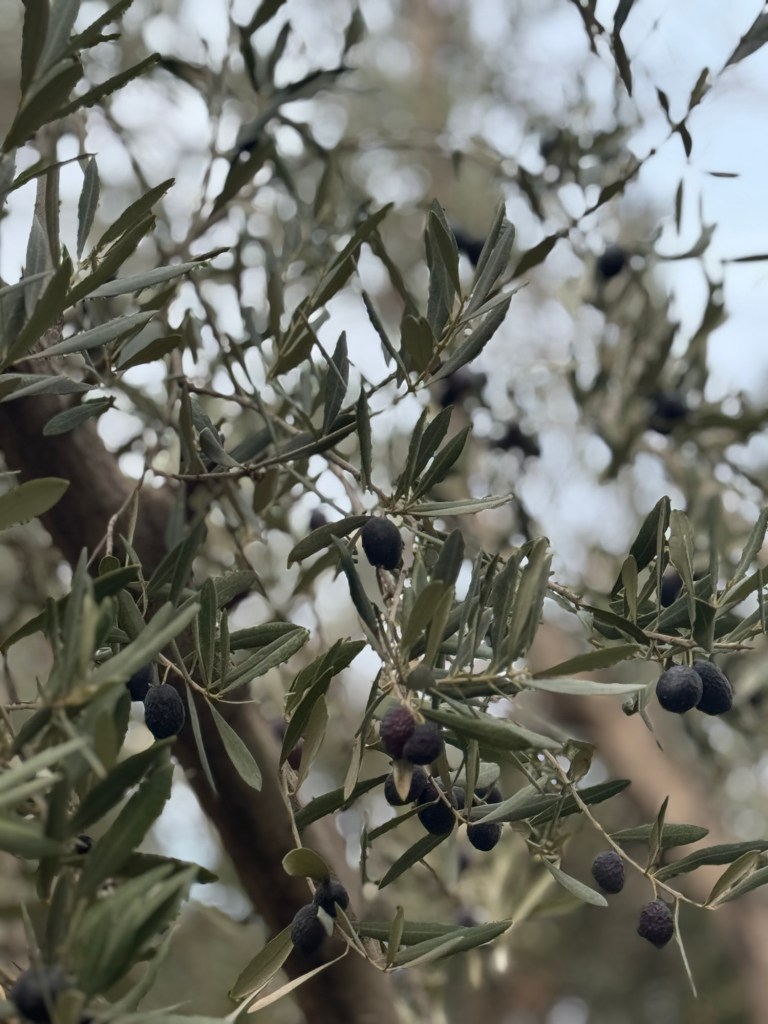
The week we were visiting, school was out for the olive harvest. We witnessed a lot of harvesting being done, but somehow the children also found time for soccer.


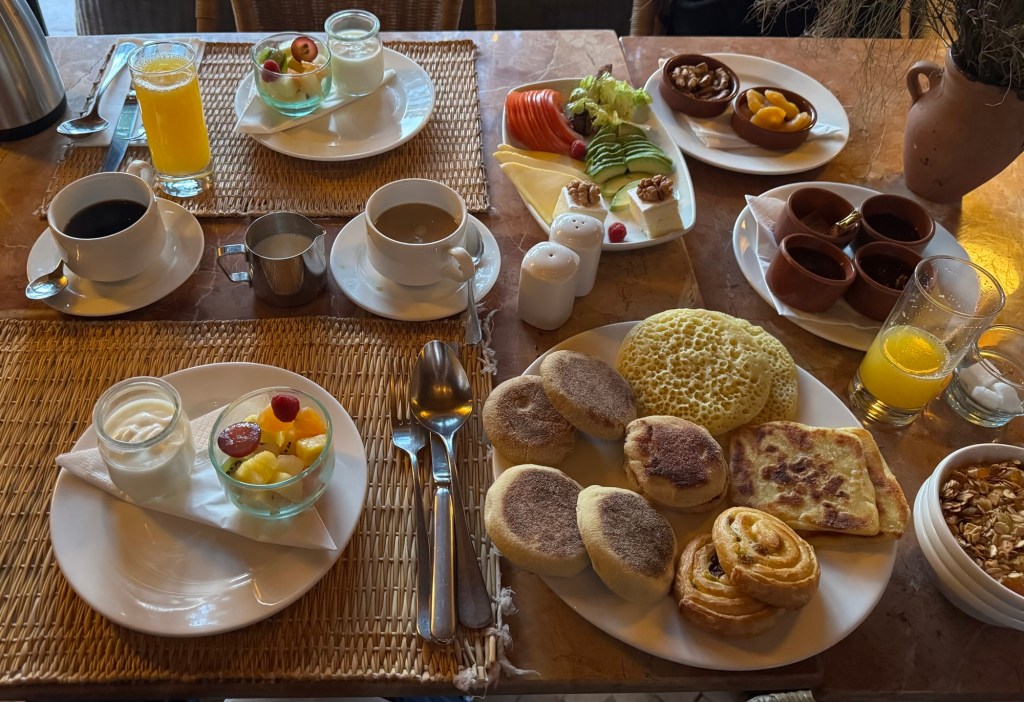
In addition to olives, there were many other local foods that were served. The breakfasts were huge. The bread looked amazing, but this gluten-free girl didn’t chance any unwanted reactions to the wheat.
One of our guides during our stay in Skoura was a former guide in the Atlas Mountains. Now that he’s older he stays local or takes tourists to the desert to glamp. He taught us that there is a difference in nomads and caravans. Nomads travel/move to feed their livestock while caravans were organized trading groups who moved goods between cities. Caravans often used the nomads’ knowledge of the land, weather and wells to complete their journeys. If an image of camels linked together walking through desert terrain comes to mind, those are the caravans.
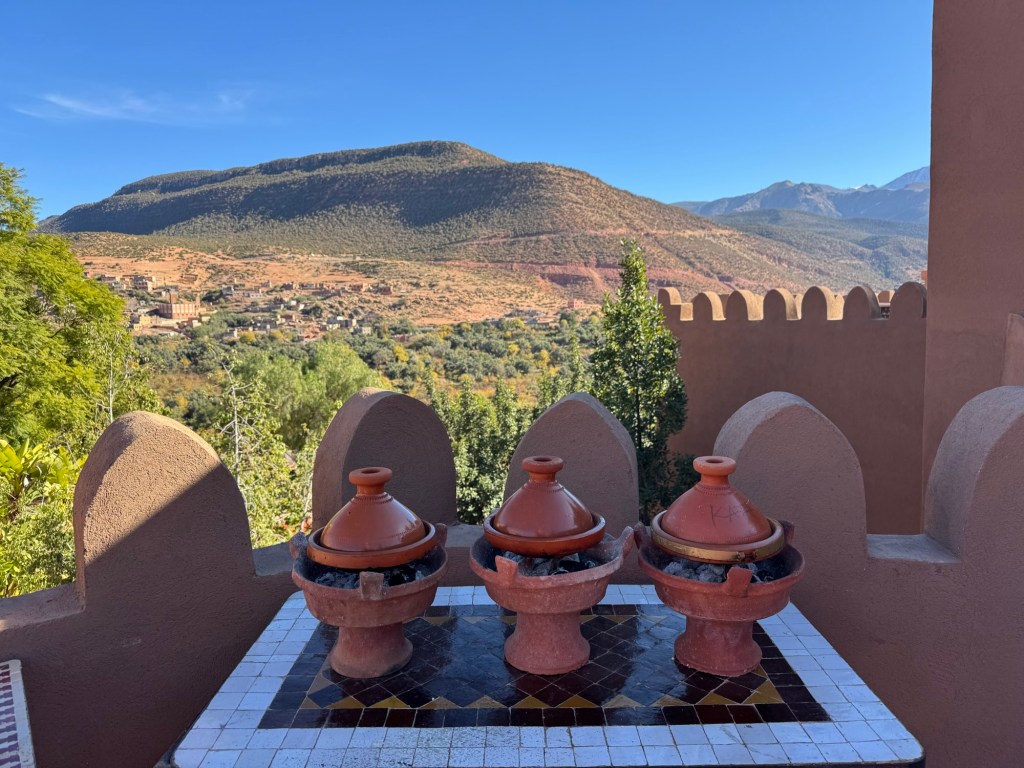
Two things specific to Morocco are tagines and hammams. Tagines are meals cooked in a specific dish (also called a tagine). While we were in Morocco we had chicken, lamb, vegetable and omelet tangines. The pot is thought to have been created by the nomadic Berbers. They are small and require little water or fuel. And the food is delicious. We made chicken tangine in our cooking class.
My second discovery specific to Morocco is the hammam. It’s a public bath—part ritual, part social space, and part deep clean. You move through warm to hot rooms, letting steam open the pores, before being scrubbed head-to-toe with black olive soap and a coarse glove that removes layers of dead skin. Buckets of warm water are poured rather than showers, and the experience ends with rinsing, rest, and often mint tea.
Of course I had to try one but in a spa like setting – no communal bath for me. Gorgeous exfoliated soft skin was a welcomed result.

On our last night at our hotel near Skoura, one of the hosts donned traditional North African clothing and taught us three local music styles on his 12-string Lute: traditional Arabic music, Amazigh (Berber) music and slave music.
The Berber music was fast paced and reminded me of Appalachian music. Think “Dueling Banjos”, but played on a single lute. Slave music, by contract, evoked U.S. gospel music and is played in Morocco on only three strings of the lute.
After several songs, he showed us a mockup of the instrument he built himself as a child to learn to play, and a Moroccan ribab – an instrument that looks a bit like a banjo but, with a single string played with a bow.
I absolutely gushed over how talented he was. We saw him the next morning (back in his host attire) as we were leaving, and I gushed again about his talent.
If you’re familiar with Islam and its central tenet of humility, you may already know my mistake. It wasn’t until several days later when reading about Yusuf Islam, formerly Cat Stevens, that it clicked. After converting to Islam, he gave up non-religious music, in part because concerts centered on displaying personal talent—something at odds with humility. In his recently published autobiography, Cat on the Road to Findout, he laments that he might not have needed to give up music entirely, had he realized how deeply it helped people.
That aha moment stopped me in my tracks.
Instead of gushing over our host’s talent, I should’ve focused on how much we learned through his music – the history, the culture, the storytelling, etc. If I’m ever in a similar situation, I hope I remember to honor the knowledge shared, not the talent displayed. Thank you, Yusuf Islam. I look forward to to reading your new autobiography in the coming year.

Speaking of Islam, I was so taken by the scenic mosques in all the villages and towns. I’ve read that there are +/- 50,000 mosques in Morocco. I think I have photos of most of them. 😂 I also learned that the square shaped tower is found mostly in the western Islamic world: Morocco, Algeria, and Tunisia. This tradition of square towers comes from early Islamic and Amazigh (Berber) architecture, influenced by Roman and pre-Islamic North African watchtowers.

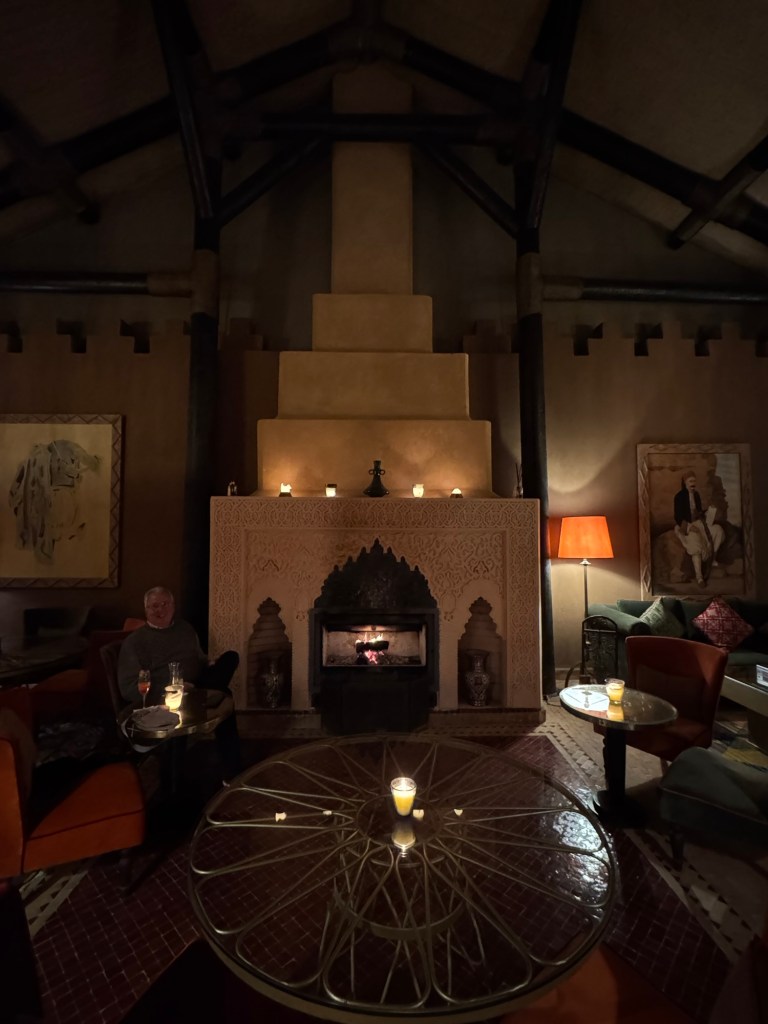
Though we relocated every few days, often spending hours on the road – this Moroccan trip became my most relaxing vacation, bar none. The soothing calls to prayer, breathtaking landscape, exquisite food and service, as well as, fires in the evenings to take the chill out of the evening air, all blended into an unforgettable experience.
 New City New State
How nice! Enjoy – I was so very close to Morocco last year, but could not convince my husband we had time to go! Next visit! Happy New Year! Sarah
LikeLiked by 1 person
We’ve not been to Spain, so our next trip to Morocco will include Spain. Happy New Year! 🎊
LikeLike
All sounds amazing! Thanks for sharing!
Christine
LikeLiked by 1 person